The Curly Girl Method for Arab Hair: A Beginner's Guide

There is a moment that almost every Arab woman with curly hair can describe with startling precision. She is standing in front of a mirror, maybe she is 12, maybe she is 24 and she is holding a brush. The kind of brush that has no business going anywhere near a curl. And she is pulling. And pulling. Until the wave is gone, until the coil is defeated, until what is left is a frizzy, defeated cloud of hair that looks nothing like the sleek, straight result she was chasing and nothing like the glorious, defined curls she was born with.
She has been told, in a thousand quiet ways, that her natural hair is too much. Too big. Too unpredictable. Too difficult.
This guide is for her. And for every Arab woman who came after her, and every one who is still standing in front of that mirror, brush in hand, wondering why her hair won't cooperate when the truth is, her hair was never the problem. The methods were.
A LEGACY WORTH RECLAIMING
Arab hair is not a problem to be solved. It is a heritage to be honoured.
Across the Middle East, North Africa, and the Levant, curly, wavy, and coily hair has been worn with pride for centuries - oiled with argan and black seed, braided with intention, adorned with gold. The relationship between Arab women and their hair has always been intimate, ceremonial, passed from mother to daughter like a sacred text.
Somewhere along the way, that text got rewritten. Straightening became the default. Products formulated for different hair types flooded the market. And generations of women with 2B waves and 3C spirals and 4A coils were handed instructions that had absolutely nothing to do with the hair on their heads.
The Curly Girl Method changed that. Not perfectly, not overnight but it started a conversation that the beauty industry had been avoiding for far too long. And for Arab women specifically, learning to apply this method to their unique hair texture has been nothing short of transformative.
This is your beginner's guide to starting that journey.
WHAT IS THE CURLY GIRL METHOD, REALLY?
The Curly Girl Method, first introduced by author Lorraine Massey in her 2001 book Curly Girl: The Handbook, is built on a philosophy rather than a rigid prescription. At its core, it asks one foundational question: what does curly hair actually need — and what has been stripping it of those things?
The answers are simpler than you might expect.
Curly hair needs moisture. It needs gentle handling. It needs to be defined, not disturbed. And it needs to be freed from the ingredients and habits that have been working against it, often under the guise of being helpful.
The method's most well-known principles include eliminating sulfates from shampoos, removing silicones from conditioners and styling products, reducing heat styling dramatically, and adopting techniques like co-washing, plopping, and scrunching that work with the curl pattern instead of fighting it.
For many women, the first few weeks of following these principles feel strange and unfamiliar. That is completely normal. You are essentially allowing your hair to remember who it is. And for Arab hair, which has been through decades of mistreatment, heat damage, and product overload, remembering can take a little time. But it comes. It always comes.
UNDERSTANDING ARAB CURL TYPES
Before you can care for your curls, you need to understand them. Arab hair does not fall neatly into a single category, it is one of the most diverse hair textures in the world, shaped by genetics that span the Mediterranean, the Arabian Peninsula, the Horn of Africa, and everywhere in between.
Wavy hair (Type 2B–2C) is common among women with Levantine, Egyptian, and North African heritage. These waves have an S-shape that begins close to the root, and they tend to be fine to medium in thickness. They are prone to frizz and can easily be weighed down by heavy products, but they define beautifully with the right lightweight gel or cream.
Curly hair (Type 3A–3C) is the range that many Gulf Arab, Yemeni, and Moroccan women fall into. These curls spiral from the root in defined, springy coils. They have more volume than wavy hair, require more moisture, and respond extraordinarily well to deep conditioning and the plop method, which we'll come to shortly.
Coily hair (Type 4A–4B) is seen across women with Sub-Saharan and East African ancestry, as well as women of mixed Arab and African heritage. This texture forms tight, dense coils or zig-zag patterns and has the highest need for moisture of all curl types. It is also the most fragile, prone to shrinkage and breakage when handled incorrectly.
Knowing where your hair falls on this spectrum matters because the Curly Girl Method is not a one-size-fits-all system, it is a framework that you personalise. A product that defines a 2C wave might not do anything for a 4A coil. A technique that works for your friend's curls might not work for yours. The journey is about learning your hair's specific language and then speaking it fluently.
THE CURLY GIRL ROUTINE, STEP BY STEP
Step 1: The Final Wash
Every Curly Girl journey begins with what is called the final wash, a one-time use of a clarifying or sulfate-containing shampoo to strip away all the silicone buildup that has accumulated from years of conventional products. This is important because silicones, while they make hair look shiny in the short term, create a barrier that prevents moisture from penetrating the hair shaft. You need to remove them before you can begin properly hydrating your hair.
After this initial wash, the goal is to transition to a sulfate-free, silicone-free routine.
Step 2: Co-Wash or Low-Poo
Co-washing, which is what you call washing with conditioner instead of shampoo, is a cornerstone of the Curly Girl Method for many curl types. The logic is simple: sulfates are designed to remove oil, and curly hair needs oil. By cleansing with a moisturising conditioner instead, you clean the scalp without stripping the hair of the natural moisture it desperately needs.
For Arab women with oily scalps, which is common in the Gulf's humid climate, a full co-wash can sometimes feel like it leaves the scalp heavy or unclean. In this case, a low-poo (a gentle, sulfate-free shampoo that cleanses without stripping) is an excellent alternative. The goal is to find the cleanest route to a clean scalp that doesn't leave your curls parched.
Step 3: Deep Condition
If there is one step in the entire method that Arab hair needs more than any other, it is this one. Deep conditioning is not optional. It is the foundation.
Arab curls, particularly coily and tightly curled textures are structurally prone to dryness because the natural oils produced by the scalp have a difficult time traveling down the spiral of the hair shaft. This means that even with a healthy scalp, the ends of your curls can be desperately thirsty. Deep conditioning once a week, with a rich, penetrating treatment formulated for curly hair, replenishes that moisture from the inside out.
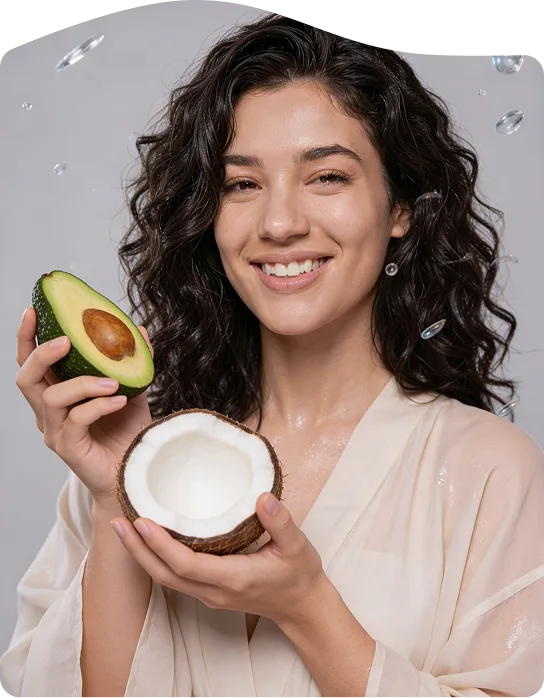
Look for ingredients that your hair has historically loved such as avocado oil, which is rich in fatty acids that penetrate the hair shaft rather than just coating it; coconut extract, which has been a staple of Arab hair care for centuries and works to reduce protein loss during washing; and hyaluronic acid, a humectant that draws moisture from the environment and locks it into the hair.
Parachute Advansed Hydra Curls is formulated with exactly this combination : Avocado, coconut, and hyaluronic acid, designed specifically for the hydration needs of Arab curly, wavy, and coily hair. It delivers 48-hour ultra hydration without weighing the curl down, and without any of the sulfates, silicones, or harsh ingredients that have been working against your hair all this time.
Step 4: Apply Your Styling Products on Wet Hair
This is one of the most important technique shifts in the Curly Girl Method, and one that surprises almost every beginner: styling products must go on soaking wet hair. Not towel-dried. Not slightly damp. Dripping wet.
The reason is science. Curly hair absorbs product most effectively when the cuticle is open, which it is when the hair is saturated with water. Applying gel, cream, or a leave-in conditioner to wet hair allows the product to distribute evenly along each curl, coating and defining it before it begins to dry.
The technique here matters as much as the timing. Scrunch the product upward, toward the scalp, encouraging the curl to form rather than pulling it down. Do not rake the product through. Do not disturb the curl pattern. Let the product do its work, and let the curl find its shape.
Step 5: Plop
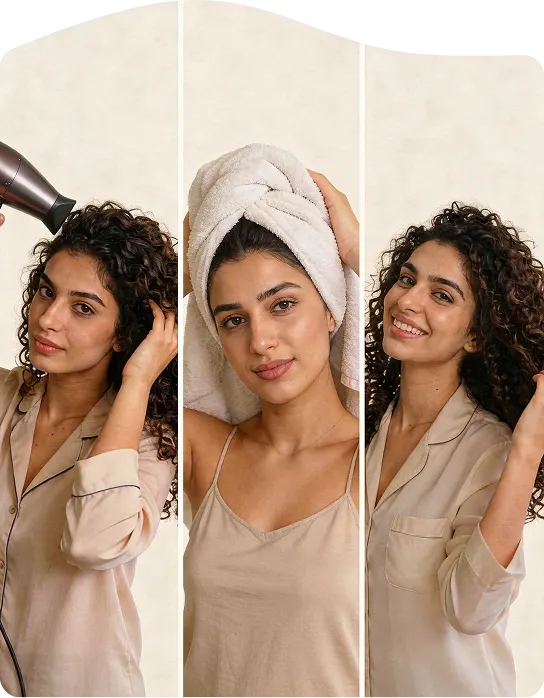
Plopping is the Curly Girl Method's answer to towel-drying and it is a revelation for most beginners. Instead of rubbing your hair with a rough cotton towel (which causes frizz by roughing up the hair cuticle), you place your wet, product-coated curls into a microfibre towel or a cotton T-shirt that has been laid flat on a surface, then fold and wrap the fabric around your head.
The plop absorbs excess water gently, without disturbing the curl pattern, and encourages the curls to stack on top of each other, which gives definition and volume rather than the flat, frizzy result that conventional towel-drying produces.
Leave the plop in place for fifteen to thirty minutes, then gently release your curls and allow them to air dry, or diffuse on low heat.
Step 6: Scrunch Out the Crunch
If you've used a gel in your routine, your curls will likely dry with a stiff, crunchy cast around them. This is not a bad thing, it means the gel did its job. Once your hair is fully dry, scrunch the curls gently between your palms to break that cast, and what emerges are soft, defined, frizz-free curls.
This step is called the SOTC (Scrunch Out The Crunch) and it is the moment most Curly Girl beginners experience their first genuine sense of wonder at what their natural hair is capable of.
THE EMOTIONAL COMPLEXITY OF THE CURLY GIRL JOURNEY
It would be dishonest to write about the Curly Girl Method without acknowledging that for many Arab women, this journey is not simply cosmetic. It is emotional. It is political. It is, in some ways, an act of quiet defiance.
To choose your natural hair in a culture that has long equated straightness with professionalism, elegance, and beauty is a brave thing. To look at a lifetime of fighting your own reflection and decide gently, deliberately, because to stop fighting, is a profound shift.
There will be bad curl days. There will be weeks in the transition period where your hair feels worse before it feels better, where the frizz seems to multiply before it learns to settle. There will be moments of doubt, when the straightener seems like the easier answer.
Give yourself grace in those moments. Your hair is undoing years of damage and learning, for the first time, how to be itself. That takes time. It takes patience. It takes the willingness to sit with the process rather than rush the result.
What awaits you on the other side of that patience is worth every difficult day.
YOUR HAIR ALWAYS KNEW WHO IT WAS
The Curly Girl Method does not create beautiful curls. It simply removes everything that was preventing them from appearing.
Your hair has always known its shape. It has always known its texture. It has been carrying that knowledge in every single strand since the day you were born, inherited from your mother, and her mother, and all the women before them who wore their curls with pride who understood the beauty of a spiral.
You were always meant to have this hair. This full, alive, textured, magnificent hair.
Parachute Advansed Hydra Curls was made for this moment, for the Arab woman beginning her curl journey, looking for a clean, effective, lovingly formulated regimen that understands her hair's specific needs. No nasties. No drama. Just 48 hours of deep hydration, zero frizz, and the kind of bounce and definition that makes you wonder why it took you so long to start.
It didn't take too long. You're here now.
And your curls are ready.