Diffuse, Plop or Air-Dry in the GCC? The Drying Method Matrix

Nobody tells you about the drying problem.
They tell you about the shampoo. They tell you about the conditioner, the deep mask, the leave-in, the gel. They guide you through detangling and product application and scrunching technique with great care and specificity.
And then they say: allow it to dry naturally.
For a woman with curly hair living in London or Toronto or Seattle, that instruction makes sense. The air is cool. The humidity is manageable. The curls dry slowly and gently, held in place by their styling products, arriving at a defined, frizzy-free finish somewhere between one and two hours later.
For a woman standing in Dubai in August, or in Jeddah in June, or on a humid evening in Doha in the middle of September, that instruction is something between optimistic and impossible.
Because in the GCC, the air is never neutral. It is never simply the background against which your curls dry. It is an active force, with its own humidity levels and its own heat and its own intentions for your hair. And if you do not understand how to dry curly hair correctly in this specific climate, you will do everything else right and still arrive at a result that does not reflect the work you put in.
This is the guide that fills that gap. A complete, honest, and deeply considered matrix of the three primary drying methods available to GCC curly girls, with everything you need to know about when to use each one, how to do it correctly, and what your hair is actually asking for when you step out of the shower.
WHY THE GCC CHANGES EVERYTHING ABOUT HOW YOU DRY
The Curly Girl Method was not written for the Gulf. This is not a criticism of the method itself, which is genuinely transformative for curl types around the world. It is simply a fact that its original framework assumed a temperate climate, and the GCC is anything but.
Understanding how to dry curly hair in this region requires understanding two conditions that make the Gulf uniquely challenging for curls.
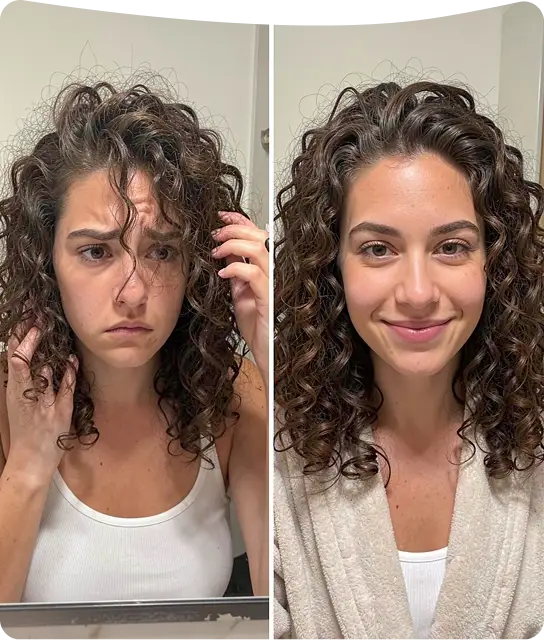
The first is summer humidity. In coastal Gulf cities, humidity levels during the summer months frequently climb above 80 percent. At these levels, the air is so saturated with moisture that wet hair exposed to it does not simply dry slowly. It absorbs additional atmospheric moisture, which causes the hair cuticle to swell and expand, disrupting the curl pattern that your styling products just worked to create. The result is frizz that arrives before your hair has even had a chance to fully form.
The second condition is air conditioning. Because outdoor heat is so extreme in the Gulf for much of the year, most women move constantly between two climate environments: sweltering outdoor air and aggressively cooled indoor spaces. Very dry, cold air conditioning pulls moisture out of the hair cuticle, which causes a different kind of damage: not frizz, exactly, but brittleness, static, and a loss of the soft bounce that healthy curls carry.
Knowing how to dry curly hair well in the GCC means navigating both of these conditions, depending on the season, the time of day, and where you are spending your wash day. None of the three drying methods is universally correct. All of them have their place. The matrix below will show you exactly when each one belongs.
METHOD ONE: DIFFUSING
Of the three methods, diffusing offers the most direct response to the GCC humidity problem. It is the method that most reliably produces defined, frizz-free results in high-humidity conditions, and it is the one that most GCC curly girls will reach for most often during the summer months.
A diffuser is an attachment that fits over the nozzle of a standard hair dryer. Instead of concentrating airflow into a single, powerful stream that would blow your curls apart and cause irreversible frizz, a diffuser redistributes that airflow into a wide, gentle, multi-directional pattern. The effect is that heat and air are applied to the hair without disturbing the curl formation that your products just created.
The most important thing to know about diffusing is that the settings matter enormously. High heat is the enemy of curl definition. It forces the cuticle open, disrupts the hydrogen bonds that give curls their shape, and creates the exact frizz you are trying to prevent. The correct setting for diffusing is always the lowest heat available, combined with the lowest speed. It should feel almost too gentle. That gentleness is the point.
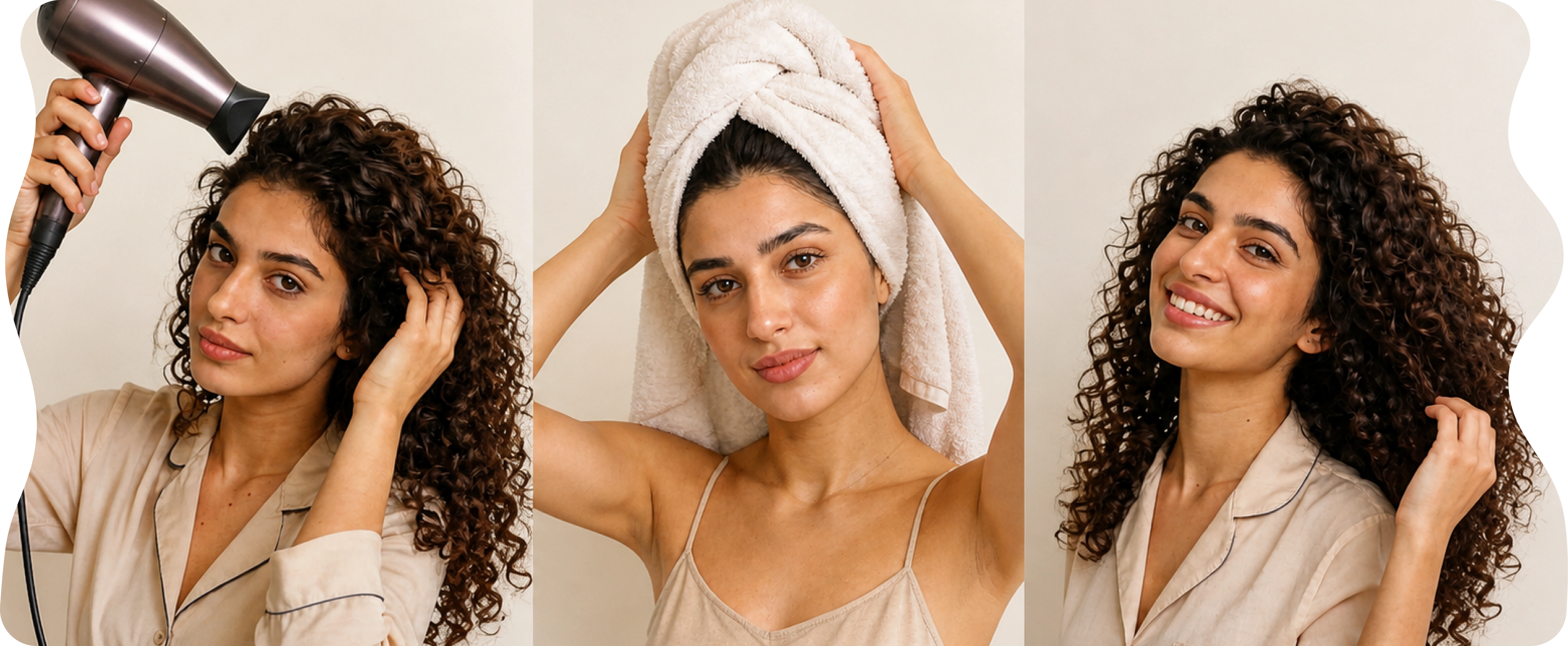
The technique is equally important. Rather than moving the diffuser constantly across your hair, work in sections. Tip your head to one side and place a section of curls into the diffuser bowl from below, bringing the tool up toward your scalp rather than pulling your hair down toward the tool. Hold it in place for thirty to sixty seconds, then move to the next section. This approach allows each curl cluster to dry in its natural formation rather than being disturbed mid-process.
For GCC curly girls, diffusing has one additional benefit that is easy to overlook: speed. Because high humidity means your wet curls are exposed to frizz-causing atmospheric moisture with every minute they remain undried, the faster you move your hair from wet to fully dry, the better your results will be. Diffusing can reduce drying time by 60 to 70 percent compared to air-drying, which means significantly less exposure time to the humidity outside or to the drying effects of indoor air conditioning.
A note on product quantity for GCC diffusing: because you are working in a climate that actively challenges curl definition, you will generally need slightly more curl defining gel than standard guidance suggests. A generous, even application that fully coats each curl before diffusing will create a stronger protective cast around each spiral, locking in the definition you want before heat and humidity have a chance to interfere.
METHOD TWO: PLOPPING
Plopping is not, strictly speaking, a drying method. It is a preparation step that dramatically improves the results of whichever drying method follows it. But it is worth treating as its own chapter here, because for GCC curly girls, plopping addresses a specific and common problem that no amount of product adjustment can solve on its own.
That problem is weight.
When your hair is freshly washed and coated with styling products, it is heavy. That weight pulls your curls downward, elongating them away from their natural shape and flattening the volume at your roots. If you proceed directly from the shower to air-drying or diffusing with dripping wet hair, gravity works against every curl from the very first moment.
Plopping removes the excess water before drying begins. The technique involves placing your freshly styled, product-coated hair into a microfibre towel or a smooth cotton T-shirt that has been laid flat on a surface. You then fold the sides of the fabric up around your head, creating a gentle nest in which your curls sit stacked on top of each other rather than hanging downward. Leave the plop in place for fifteen to thirty minutes, depending on your curl type and hair thickness.
When you release the plop, two things have happened. First, the excess water has been absorbed by the fabric, without any of the friction or cuticle disturbance that rubbing with a regular cotton towel would cause. Second, your curls have begun to set in their natural formation, with the cast of your styling gel already starting to form around each spiral.
The fabric you choose matters. Microfibre is ideal for most curl types because it absorbs water efficiently without creating friction. For very coily or high-porosity hair, a smooth cotton T-shirt may actually be preferable; microfibre can occasionally be too absorbent for denser textures, removing moisture that the hair still needs.
In the GCC context, plopping belongs at the beginning of every wash day routine, regardless of which drying method follows. During summer months, plop first, then diffuse. During the cooler winter months when air-drying becomes more viable, plop first and then air-dry. The combination of plopping and diffusing is the most consistently reliable sequence for achieving defined curls in high-humidity Gulf conditions.
METHOD THREE: AIR-DRYING
Air-drying is the method most associated with the Curly Girl Method in its original form, and it is genuinely beautiful when conditions support it. Curls that air-dry correctly have a quality that diffused curls sometimes cannot quite replicate: a softness, a lived-in naturalness, a sense of having simply been allowed to be themselves.
In the GCC, air-drying earns its place during the cooler months. Between October and April in most Gulf cities, humidity drops to manageable levels, temperatures become gentle, and the indoor-outdoor temperature differential lessens considerably. During this window, stepping out of the shower, applying your products, plopping for twenty minutes, and then releasing your hair to finish drying naturally in the indoor air can produce some of the best curl results of the year.
There are two things to get right for air-drying to work in any climate, and especially in the GCC.
The first is product application timing. For air-drying, your curl defining gel must be applied on the absolute wettest hair possible. The more water present when the gel goes on, the more evenly it distributes across each curl, and the more complete the protective cast it creates as the hair dries. If you apply gel to hair that is already somewhat dry, the cast will be uneven, and the sections that were drier will frizz before the cast fully forms.
The second is the absolute prohibition on touching your hair while it dries. Every touch, every adjustment, every curious squeeze to check how dry it is breaking the forming cast. The cast is your protection. It holds each curl in its shape while the water inside it evaporates gradually. Disturbing it at any stage of that process introduces frizz. Leave your hair entirely alone until it is completely and fully dry, then scrunch out the cast gently with your palms.
Air-drying indoors in heavy air conditioning during summer is technically possible but requires a heavier leave-in application than usual, because very dry cool air pulls moisture from the hair surface faster than it allows the hair to dry from within. If this is your only option during summer months, increase your leave-in cream quantity and ensure your gel application is generous and thorough before you begin.
YOUR DRYING METHOD MATRIX: THE QUICK REFERENCE
For GCC curly girls navigating the full range of Gulf climate conditions, here is how the three methods map to specific scenarios.
Summer months with high outdoor humidity: plop first, then diffuse. This is the most protective and most reliable sequence in challenging conditions.
Cooler winter months indoors with lower humidity: plop first, then air-dry. The gentlest and most beautiful results of the year become possible in this window.
Year-round when you are in a hurry: plop for fifteen minutes, then diffuse on low heat until fully dry.
High-porosity or coily hair in any season: diffuse is your most consistent method year-round. The greater moisture absorption of high-porosity hair makes the speed of diffusing particularly protective regardless of external conditions.
Wavy hair during winter: air-drying or a short plop followed by air-drying will serve lighter wave textures well when conditions are cooler and drier.
PRODUCTS THAT WORK WITH EVERY METHOD
Learning how to dry curly hair correctly in the GCC is only half the answer. The products you apply before drying determine what the drying process is working with.
Parachute Advansed Hydra Curls was formulated specifically for the moisture needs of Arab curly, wavy, and coily hair in conditions exactly like these. The Curl Defining Gel creates the protective cast that holds your curl definition through every drying method and shields it from humidity once it is formed. The 48-hour ultra hydration delivered by the combination of avocado oil, coconut extract, and hyaluronic acid keeps moisture locked in whether you are diffusing in dry indoor air or air-drying in a cool winter breeze.
No sulfates. No silicones. No ingredients that compromise what your drying method is trying to achieve. Just clean, intentional formulations that give your curls the foundation they need to thrive in the place they actually live.
YOUR CURLS KNOW HOW TO LAND
The knowledge of how to dry curly hair correctly becomes instinctive over time. You will learn to read the air of a particular morning and know before you step out of the shower whether today calls for a plop and diffuse or a plop and air-dry. You will understand your hair's signals in a way no guide can fully teach you, because the deepest knowledge is always the kind that comes from paying close attention to something you love.
Your curls are worth that attention. They always have been.
Give them the right method, the right products, and the climate-specific care they deserve. Watch what happens when all three arrive at once.