The Hero Ingredients for Curly Hair: Avocado, Coconut & Hyaluronic Acid

Some formulations are built. Others are remembered.
There is a particular kind of hair care wisdom that does not arrive in a laboratory. It arrives in kitchens, in gardens, in the slow, certain knowledge that accumulates across generations of women who paid close attention to the earth around them and understood, long before modern science caught up, which gifts it was offering.
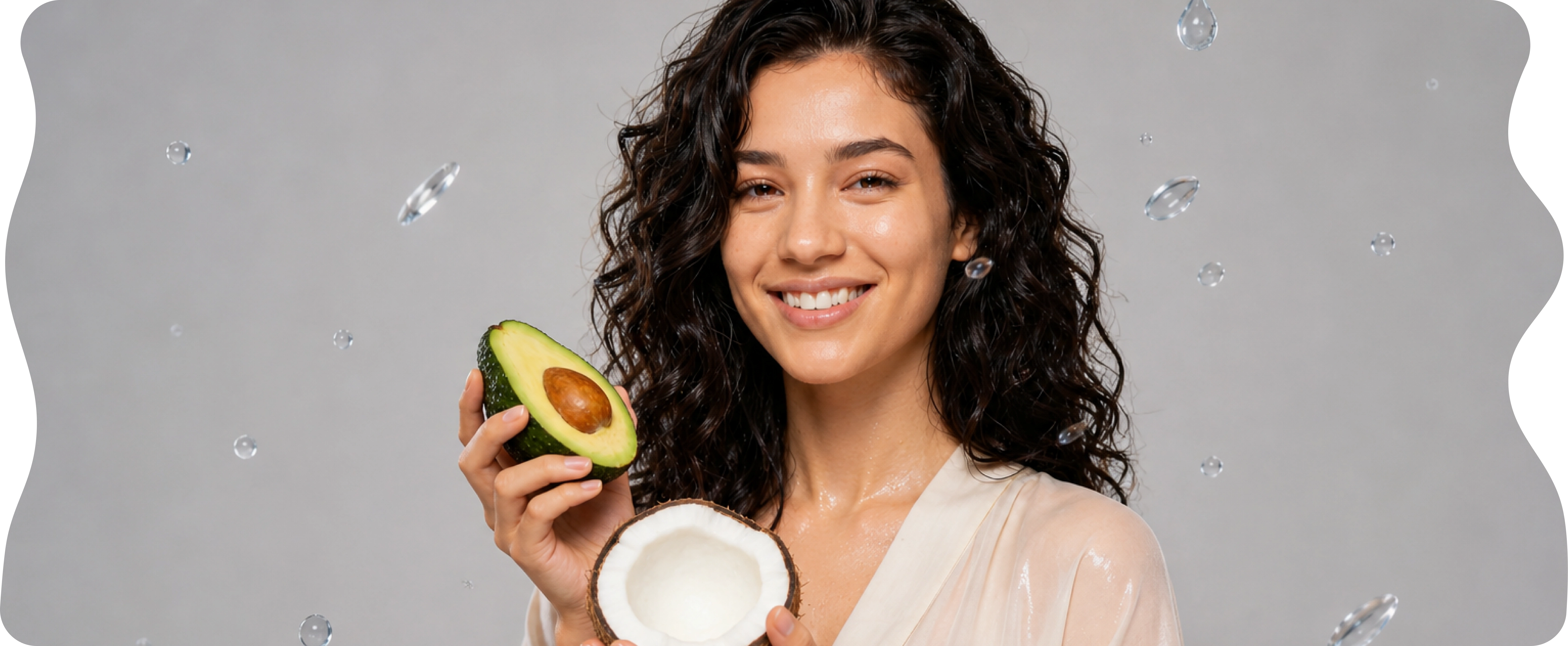
The three ingredients at the heart of Parachute Advansed Hydra Curls are not inventions. They are inheritances. Avocado, coconut, and hyaluronic acid each carry a history that stretches back centuries in the case of the first two, and decades of scientific rediscovery in the case of the third. Together, they form what is, for Arab curly, wavy, and coily hair, one of the most potent and purposeful combinations of the best ingredients for curly hair that formulation science has ever arrived at.
This is their story. Not just the science, though the science is extraordinary. But the legacy, the tradition, the long journey from soil and sea to the bottle on your bathroom shelf.
AVOCADO OIL: THE ANCIENT ANSWER TO THIRSTY HAIR
A History That Begins Before History Keeps Records
The avocado tree is believed to have originated in the highlands of Mexico and Central America, where indigenous Mesoamerican civilisations were cultivating it as far back as 5,000 BCE. Archaeological evidence suggests that avocado consumption and use predates written record, woven into the fabric of pre-Columbian life not just as a food source but as a material for skin and hair care.
The Aztecs called it "ahuacatl" and used its oil for everything from wound treatment to protecting skin and hair against the sun and wind that characterised their highland environment. When Spanish conquistadors arrived in the 16th century, they brought the avocado back to Europe, and within a century it had spread across the Mediterranean and eventually to Africa, the Middle East, and Asia.
What makes avocado's journey into hair care so significant is that it was never a modern discovery. It was a rediscovery. The beauty industry of the 20th century arrived at avocado oil and found communities around the world already using it, quietly and without ceremony, because it worked.
What Avocado Oil Actually Does to Curly Hair
The modern scientific understanding of avocado oil reveals why those ancient communities were right to trust it.
Avocado oil is one of only a handful of oils that genuinely penetrates the hair shaft rather than simply sitting on top of it. This distinction matters enormously for understanding why it is among the best ingredients for curly hair. Most oils, including many that are widely celebrated in hair care, are too large at the molecular level to pass through the hair cuticle. They create a coating on the outside of the hair strand, which provides surface-level smoothness and shine but does not address the structural dryness that originates inside the cortex.
Avocado oil is different. Its unusually high oleic acid content, which comprises between 50 and 80 percent of its fatty acid profile, gives it a molecular size small enough to penetrate the cuticle and reach the hair cortex. Once inside, it replenishes the lipid content that has been stripped away by washing, heat, and environmental exposure. For curly hair, which is structurally more prone to dryness because the natural oils produced at the scalp have difficulty travelling down the spiral of the hair shaft, this penetrative ability is not a bonus. It is essential.
Avocado oil is also exceptionally rich in vitamins A, D, E, and B6, as well as potassium, lecithin, and magnesium. Vitamin E is a particularly important component for curly hair: it is a potent antioxidant that protects the hair from oxidative stress caused by UV exposure (which is significant in GCC climates) and environmental pollution. Lecithin, meanwhile, acts as a natural emulsifier that helps the oil distribute evenly through the hair and aids in moisture retention after application.
What many people do not know about avocado oil is that it also contains sterolins, a class of plant steroids that have been shown to soften the hair and increase the porosity of the cuticle layer. For high-porosity curly hair that loses moisture quickly, this sounds counterintuitive. But sterolins work in a balanced way, softening the cuticle enough to allow moisture to enter more easily without compromising the cuticle's ability to seal that moisture in once it has been absorbed.
The result, for curly hair, is elasticity. The spring that a healthy curl should have. The resistance to breakage. The softness that does not come at the cost of definition.
COCONUT EXTRACT: THE SACRED OIL OF A THOUSAND YEARS
A Story Carried Across Every Ocean
The coconut palm has been called the tree of life across dozens of cultures and for good reason. Across Southeast Asia, the Pacific Islands, the Indian subcontinent, and the Arabian Peninsula, the coconut has provided food, water, fuel, building material, and one of the most versatile natural oils the world has ever known for at least three thousand years.
The use of coconut extract in hair care is documented as far back as 1500 BCE in ancient Indian Ayurvedic texts, where it appears repeatedly as a treatment for scalp health, hair strength, and the prevention of premature greying. In the Pacific Islands, coconut extract was mixed with fragrant flowers and applied to the hair as both a conditioning treatment and a form of personal and ceremonial adornment. In Sri Lanka and South India, the tradition of mothers oiling their children's hair with coconut extract before school is so culturally embedded that it has survived industrialisation, urbanisation, and the flood of synthetic hair care products that arrived in the 20th century.
In the Arab world, coconut extract was introduced through trade routes that connected the Gulf with South Asia and East Africa, and it became part of the traditional hair care rituals of communities across the region, used alongside black seed oil and argan oil as part of a holistic approach to hair health that understood nourishment as something that began at the scalp and moved outward.
Why Coconut Extract Remains Irreplaceable for Curly Hair
The modern science of coconut extract has confirmed what thousands of years of traditional use already knew. Its primary fatty acid, lauric acid, has a uniquely straight molecular structure and a low molecular weight that, like avocado oil, allows it to penetrate the hair shaft and work from within.
But coconut extract's most significant and scientifically documented contribution to curly hair health is its ability to reduce protein loss during washing. This is a property that is little understood by most consumers but is among the most important things an oil can do for the structural integrity of the hair.
Every time curly hair is washed, whether with a sulfate shampoo or a gentle co-wash, the mechanical process of wetting, working, and rinsing the hair causes a degree of protein loss from the hair shaft. Over time, this cumulative protein loss weakens the hair fibre, reduces elasticity, and increases breakage, particularly at the fragile points of a curl where the hair naturally bends and twists. A landmark study published in the Journal of Cosmetic Science demonstrated that pre-treating hair with coconut extract before washing significantly reduced this protein loss compared to both mineral oil and sunflower oil, which did not penetrate the shaft to the same degree. The mechanism is the lauric acid binding to the protein structure of the hair in a way that protects it from the mechanical and chemical stresses of washing.
For curly hair, which undergoes washing and manipulation regularly and which already has fewer cuticle layers protecting the cortex compared to straight hair, this protein protection is not a minor advantage. It is one of the most fundamentally beneficial things a hair care ingredient can do.
What many people do not know is that coconut extract also has a significant antifungal and antibacterial effect on the scalp. Malassezia, the yeast species associated with dandruff and scalp irritation, is inhibited by the lauric and caprylic acid content of coconut extract. For people with sensitive or reactive scalps, the scalp-conditioning effects of coconut extract extend far beyond simple moisturisation into genuine microbiome support.
In the Hydra Curls formulation, coconut extract functions in perfect partnership with avocado oil: while avocado penetrates to restore and replenish the interior of the hair shaft, coconut extract protects that interior investment by reducing the protein loss that would otherwise gradually undo it.
HYALURONIC ACID: THE MODERN MIRACLE WITH AN ANCIENT BODY
Not Where You Would Expect to Find It
Of the three hero ingredients, hyaluronic acid is the one that seems to belong to a different world. It is a word associated with serums and injectable treatments and the language of anti-ageing skincare. It arrived in beauty product formulations relatively recently, becoming mainstream in facial skin care in the 1990s and early 2000s as dermatologists began to understand its extraordinary water-binding capacity.
But here is what most people do not know: hyaluronic acid is not a synthetic invention. It is a naturally occurring molecule that the human body produces and has always produced, present in the connective tissue, the eyes, the skin, and in small concentrations in the scalp. Its role in the body is to hold moisture within cells, and it performs that function with an efficiency that no other known molecule can match: a single gram of hyaluronic acid is capable of holding up to six litres of water.
Its application to hair care came later than its adoption in skin care, but the logic was always compelling. If hyaluronic acid could transform the hydration capacity of the skin, which is structurally somewhat analogous to the hair cuticle in terms of its moisture management challenges, what could it do for curly hair, which is among the most chronically dehydrated fibre types in the world?
The Science That Makes Hyaluronic Acid Uniquely Powerful for Curly Hair
Hyaluronic acid is a humectant. The term means that it works by drawing moisture from the surrounding environment and binding it to the surface or interior of whatever it is applied to. For skin, this means drawing moisture up from the deeper layers of the dermis. For hair, it means drawing moisture from both the atmosphere around the hair and from the water present in the hair fibre itself, retaining it in a form that the hair can access over an extended period.
This mechanism makes hyaluronic acid different from conditioning ingredients that simply coat the hair surface with an occlusive layer. Those ingredients seal moisture in, which is valuable. But hyaluronic acid actively collects moisture and holds it in a dynamic, available state. For curly hair in the GCC, where the relationship between the hair and atmospheric moisture is complicated by extreme humidity in summer and aggressive air conditioning in winter, this dynamic moisture management is particularly important.
One property of hyaluronic acid that is rarely discussed outside dermatological literature is its molecular flexibility. Hyaluronic acid is available in formulations at different molecular weights. Higher molecular weight hyaluronic acid sits on the surface of the hair and forms a hydrating film that reduces friction between hair strands and decreases frizz. Lower molecular weight hyaluronic acid penetrates into the cuticle itself and works at a deeper level to replenish moisture within the fibre. The most sophisticated formulations, including Hydra Curls, utilise hyaluronic acid in a way that addresses the hair at both of these levels simultaneously, delivering surface hydration and internal moisture replenishment in a single application.
What this means for curly, wavy, and coily Arab hair is a genuinely new kind of hydration: one that is not exhausted by the end of wash day but that continues working for up to 48 hours after application, responding to changes in the hair's moisture needs throughout that period. On dry days, the hyaluronic acid pulls moisture from within the hair fibre to the surface, keeping the cuticle supple. On humid days, it manages the influx of atmospheric moisture in a way that maintains definition rather than allowing the hair to frizz.
WHY THIS COMBINATION IS UNLIKE ANYTHING THAT CAME BEFORE IT
Each of these three ingredients is extraordinary on its own. The combination of all three is something else entirely.
Avocado oil penetrates the shaft and restores the lipid content that structural dryness has depleted, rebuilding the interior foundation of each curl. Coconut extract protects that rebuilt foundation from the protein loss that washing repeatedly inflicts, ensuring that the work avocado does is preserved rather than gradually undone. Hyaluronic acid then operates at the surface and within the cuticle simultaneously, holding moisture in a dynamic, responsive way that keeps the hair hydrated not just on wash day but through the days that follow.
These three mechanisms do not simply add together. They create a cascade. One prepares the ground for the next. The interior restoration that avocado oil provides makes the hair more receptive to the protein protection of coconut extract. The protein protection that coconut extract provides makes the surface integrity of the cuticle more capable of holding onto the moisture that hyaluronic acid delivers. Each ingredient amplifies the effect of the other two.
For Arab curly, wavy, and coily hair specifically, which has been waiting for a formulation built around its actual needs rather than adapted from products designed for other textures and other climates, this combination represents something genuinely new. Not a trend. Not a marketing construct. A considered, legacy-informed, scientifically grounded answer to the question that curly girls in the GCC have been asking for a very long time.
The question of how to give their hair what it has always deserved.
THE LEGACY CONTINUES
The best ingredients for curly hair are not the newest. They are the ones that were trusted long before any of us were born and have been confirmed, by everything that modern science can bring to bear, to have been worthy of that trust all along.
Avocado from the highlands of ancient Mesoamerica. Coconut from the palms of the Indian Ocean and the trade routes that carried its wisdom to every corner of the world. Hyaluronic acid, made by your own body for your entire life, finally understood well enough to be harnessed on your behalf.
These are not ingredients. They are a lineage. And now they are core ingredients that continue their legacy in the form of Parachute Advansed Hydra Curls.
And your curls are the ones who will reap the benefits of their legacy.